
Imagine you want to create custom metal parts for a project but worry about expensive equipment or complex processes. Metal stamping offers a solution. You shape flat metal sheets into precise parts using a cold-forming process with dies and presses. In 2025, you find this process more accessible than ever. Advanced machine learning models now optimize stamping, achieving a predictive accuracy (R2) of 0.951, which means fewer defects and higher efficiency. Market growth continues, with the global metal stamping market reaching $208.79 billion in 2023 and expanding at a 5.2% annual rate:
| Metric | Value | Year |
|---|---|---|
| Global metal stamping market size | $198.45 billion | 2022 |
| Global metal stamping market size | $208.79 billion | 2023 |
| CAGR | 5.2% | 2022-23 |
You can now access quality custom parts whether you are a hobbyist, a small business, or new to manufacturing. Stamping tooling manufacturers help you achieve professional results without a steep learning curve.
Key Takeaways
Metal stamping shapes flat metal sheets into precise parts using dies and presses, suitable for both small projects and mass production.
Core principles like process optimization, tool design, and quality control help produce consistent, high-quality stamped parts efficiently.
Different stamping methods—progressive die, transfer die, four-slide, and deep draw—fit various part sizes, complexities, and production volumes.
Choosing the right materials such as steel, aluminum, or copper alloys depends on your project’s strength, formability, and cost needs.
Safety is crucial; always wear protective gear, inspect equipment, use guards, and follow lockout/tagout procedures to prevent injuries.
Quality control involves regular inspections, calibrated tools, and real-time monitoring to catch defects early and maintain standards.
Starting metal stamping is easier with basic equipment and stamping kits; beginners should test materials, maintain tools, and follow step-by-step processes.
Avoid common mistakes like skipping material tests, ignoring tool maintenance, poor alignment, neglecting safety, and overlooking quality checks to ensure success.
Metal Stamping Overview
Definition
You use metal stamping to transform flat metal sheets into precise, functional parts. This process relies on cold-forming techniques such as blanking, punching, bending, and piercing. You place a metal sheet between a die and a press, then apply force to shape the material. Metal stamping supports both mass production and custom prototyping. You find this process in industries like automotive, aerospace, electronics, and medical devices.
Tip: When you start, focus on understanding the basic steps—blanking, punching, and bending. These form the foundation for more advanced techniques.
Core Principles
You achieve high efficiency and accuracy in metal stamping by following several core principles:
Process Optimization: You monitor force signals and adjust lubrication to reduce friction. This extends the life of your punch tools and stabilizes production.
Tool Design: You select the right punch speed, die fillet radius, and geometric dimensions. Lower punch speeds improve formability, while larger die radii reduce the risk of cracks.
Integrated Operations: Progressive dies let you combine multiple forming steps, producing up to 14 parts per minute or over 6,000 parts in a single shift.
Quality Control: You check for factors like grain direction, bend relief, and burr minimization to ensure consistent results.
You can see how these principles work in practice by looking at a simple case. For example, when you manufacture brackets for electronics, you use progressive die stamping to cut, bend, and form each bracket in one continuous process. This reduces handling costs and improves part consistency.
Evolution to 2025
Metal stamping has evolved rapidly as you move toward 2025. You now benefit from digitalization, automation, and sustainability initiatives. Smart factories use IoT sensors and predictive maintenance to minimize downtime. You see lightweight alloys and high-strength steels replacing traditional materials, helping you meet stricter environmental standards.
Here’s a snapshot of recent market trends:
| Year | Global Market Size (USD Billion) | CAGR (%) | Key Trends |
|---|---|---|---|
| 2024 | 228.92 | 4.38 | Automation, lightweight materials |
| 2025 | 238.79 | 4.38 | Smart factories, EV components |
| 2030 | 296.13 | 4.38 | Digital twins, sustainability |
You notice that the automotive sector drives much of this growth, especially with the rise of electric vehicles. You also see new opportunities in aerospace and medical devices, where precision and lightweight parts matter most. Automation and digital tools now help you optimize every step, from design to final inspection.
FAQ
Q: Can you start metal stamping with basic equipment?
Yes, you can begin with simple presses and dies, especially for small projects or prototypes.Q: What materials work best for beginners?
Steel and aluminum are popular choices. They offer good formability and are widely available.Q: How do you ensure quality in stamped parts?
Focus on proper tool design, regular maintenance, and monitoring key process parameters.
Metal Stamping Process
Process Steps
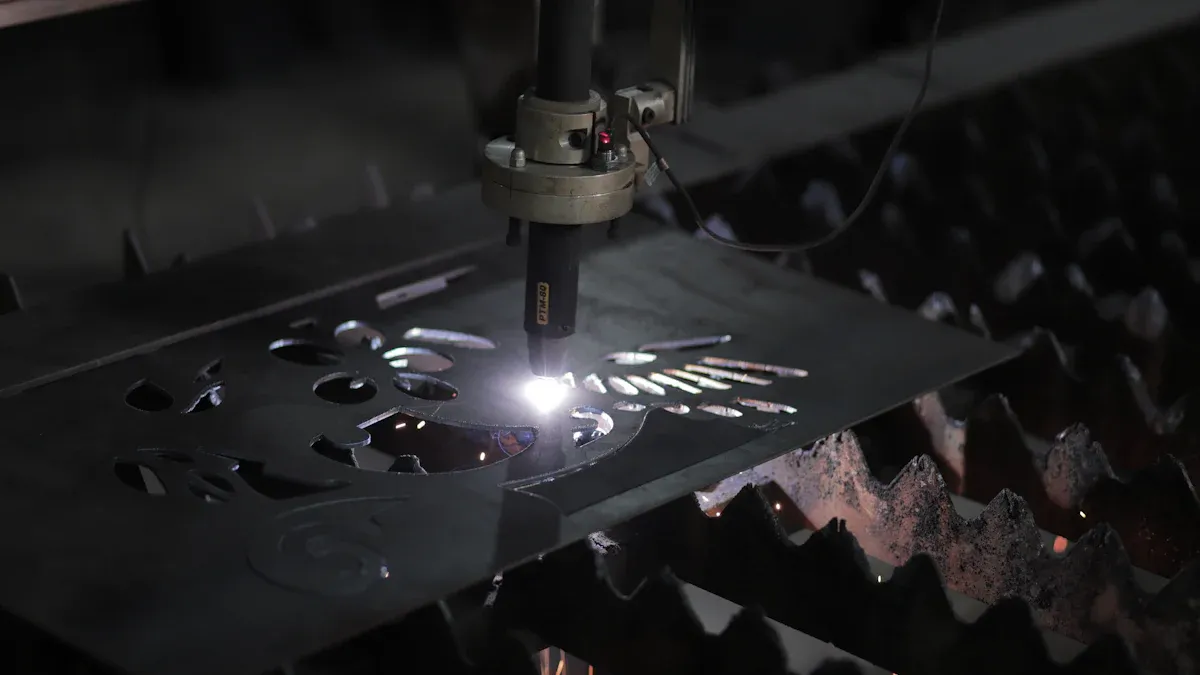
You follow a series of precise steps when you perform metal stamping. Each step uses cold-forming techniques with dies and presses to shape the metal sheet. Understanding these steps helps you achieve consistent, high-quality results whether you work on prototypes or mass production.
Blanking
You start with blanking. In this step, you cut a flat piece, called a blank, from a larger metal sheet. The blank matches the outline of your final part. You use a die and press to shear the metal cleanly. Blanking sets the foundation for all other operations. For example, when you create electrical connectors, you blank out the base shape before adding features.
Punching
Next, you move to punching. Here, you use a punch and die to create holes or cutouts in the blank. Punching removes unwanted material and forms features like slots or mounting holes. You often perform piercing at this stage to create pilot holes. These holes prevent the metal coil from slipping, which ensures part accuracy and repeatability. Punching supports high-speed production and maintains tight tolerances.
Bending
Bending comes after punching. You use a press brake or specialized die to bend the blank along straight lines or curves. Bending gives your part its three-dimensional shape. For example, you might bend a flat bracket into an L-shape for use in an automotive assembly. You control the angle and radius to avoid cracks and maintain strength.
Coining
Coining is a precision forming step. You compress the metal between a punch and die with high force. This action creates fine details, sharp edges, or specific surface textures. Coining improves dimensional accuracy and surface finish. You often use coining for parts that require tight tolerances, such as battery contacts or decorative trim.
Embossing
Embossing raises or recesses specific areas of the metal. You press the blank between a male and female die to create patterns, logos, or identification marks. Embossing adds both function and aesthetics. For instance, you might emboss serial numbers onto medical device housings for traceability.
Flanging
Flanging forms a rim or lip along the edge of the part. You use a die to bend the edge upward or downward. Flanging strengthens the part and prepares it for assembly, such as joining two panels together. You see flanging in automotive body panels and electronic enclosures.
Tip: You can combine several steps in a progressive die setup. This approach increases efficiency and reduces handling time.
Typical Process Sequence in Mass Production:
Blanking
Piercing (Punching)
Trimming
Forming (Bending, Embossing, Coining)
Additional Trimming
Cut-Off
Quality Control and Inspection
This sequence supports repeatability and dimensional accuracy. For example, when you manufacture metal brackets for electronics, you use multiple stations to trim, form, and inspect each part before final cut-off.
Process Flow
You manage the process flow to maximize efficiency and precision. You monitor each stage using real-time data and statistical tools. Load monitors track the force applied during stamping, capturing variations caused by material or tooling changes. You use control charts, such as X-bar and sigma charts, to monitor process stability. Pareto charts help you identify and prioritize the most frequent causes of downtime or defects.
You rely on this data-driven approach to reduce variation and improve quality. For instance, if you notice a spike in force readings, you investigate tool wear or material inconsistencies. You adjust parameters quickly to maintain consistent output. This method supports both high-volume production and rapid prototyping.
Note: Statistical process control (SPC) and capability studies provide proof of quality and support continuous improvement.
Quality Control
You implement rigorous quality control at every stage of metal stamping. You use calibrated measuring devices, such as laser micrometers and pin gages, to ensure accuracy. Gage Repeatability and Reproducibility (R&R) studies help you identify and reduce measurement errors. You inspect parts at setup, during production, and after tool changes to catch deviations early.
You segregate nonconforming parts immediately and maintain traceability according to ISO 9001:2015 standards. You use Acceptable Quality Level (AQL) sampling plans for final inspection, which allows you to verify lot quality without checking every part. For small or complex parts, you use go/no-go gauges for pass-fail checks.
You also monitor environmental factors, such as temperature and humidity, to maintain stamping accuracy. Advanced inspection equipment, like 3D measurement machines and profilometers, ensures dimensional and surface quality. You document all inspection results and use feedback to adjust processes or repair molds as needed.
| Quality Control Metric | Description |
|---|---|
| Equipment Maintenance | Regular inspection and adjustment of stamping equipment to ensure performance. |
| Material Inspection | Checking dimensions and properties to meet tolerance requirements. |
| Process Control | Planning and monitoring stamping parameters for each part. |
| First Sample Inspection | Full inspection of the first part before mass production. |
| In-Process Inspection | Random checks during production to detect issues early. |
| Environmental Control | Maintaining optimal conditions for accuracy. |
| Advanced Inspection Equipment | Using 3D machines and optical projectors for precise checks. |
| Data Reporting and Feedback | Analyzing inspection data to drive improvements. |
| Mold Design and Maintenance | Ensuring molds are precise and well-maintained. |
| Equipment Calibration | Regular calibration of all measurement tools. |
| Material Quality Control | Strict control of raw material properties. |
| Process Optimization | Continuous monitoring and adjustment for precision. |
| Professional Inspection Personnel | Skilled inspectors following strict procedures. |
FAQ
Q: How do you maintain accuracy in mass production?
You use calibrated tools, regular inspections, and statistical process control to detect and correct deviations quickly.Q: What if you find a defective part during production?
You remove it immediately, trace its source, and adjust the process to prevent recurrence.Q: Can you use the same process for prototypes and large batches?
Yes, you can. The process flow and quality control measures scale easily from single parts to thousands of units.
Stamping Methods
Progressive Die
You use progressive die stamping when you need high-volume production and complex part geometries. In this method, you feed a metal strip through a series of stations within a single die. Each station performs a specific operation, such as punching, bending, or cutting. The part moves from one station to the next with each press stroke. You complete the part by the time it exits the final station.
This method stands out for its speed and efficiency. For example, you can produce up to 80 parts per minute for automotive brackets that require tight tolerances. Progressive die stamping also maximizes material utilization, often reaching 85%. You find this method ideal for producing over 100,000 parts with consistent quality.
Tip: Use progressive die stamping for parts with multiple features, such as electrical connectors or appliance components. You reduce labor costs and minimize handling errors.
Transfer Die
You choose transfer die stamping for larger or more complex parts that need operations on multiple surfaces. Unlike progressive die, the part separates from the strip early in the process. Automated transfer mechanisms move the part from one station to the next. Each station can perform deep drawing, piercing, or forming on different faces of the part.
Transfer die stamping works best for medium production volumes, typically between 10,000 and 500,000 parts. Production speeds range from 15 to 60 parts per minute. You often use this method for automotive body panels or industrial pump housings. The flexibility of transfer dies allows you to form larger or deeper parts that progressive dies cannot handle efficiently.
Note: Transfer die stamping gives you more freedom in part design, especially for items that require forming on several sides.
Four-Slide
You select four-slide stamping when you need intricate bends or multiple forms in a single part. This method uses four sliding tools that approach the workpiece from different directions. You can create complex shapes, such as clips, brackets, or spring contacts, without multiple dies.
Four-slide machines excel at producing small to medium-sized parts with high repeatability. You achieve production speeds similar to progressive die stamping, but you gain more flexibility in forming operations. For example, you can manufacture a spring clip with several bends and twists in one continuous process.
Callout: Four-slide stamping reduces tooling costs for complex parts and shortens setup times. You benefit from quick changeovers when switching between part designs.
Comparative Productivity Metrics
| Stamping Method | Production Speed (parts/min) | Material Utilization (%) | Typical Batch Size (parts) | Tolerance Range (mm) | Best Application |
|---|---|---|---|---|---|
| Progressive Die | 60-80 | 70-85 | >100,000 | ±0.025 to ±0.1 | High-volume, complex parts with multiple stations |
| Transfer Die | 15-60 | 60-75 | 10,000-500,000 | ±0.05 to ±0.15 | Medium volume, large or multi-face parts |
| Four-Slide | 40-100 | 65-80 | 5,000-200,000 | ±0.05 to ±0.2 | Small, intricate parts with multiple bends |
These metrics show that progressive die stamping delivers the highest speed and material efficiency for large-scale production. Transfer die stamping offers flexibility for larger or more complex parts. Four-slide stamping provides unique advantages for intricate, multi-bend components.
FAQ
Q: When should you use progressive die stamping?
Choose it for high-volume runs and parts with multiple features.Q: What makes transfer die stamping different?
It handles larger parts and allows forming on several faces.Q: Why pick four-slide stamping?
Use it for small, complex parts that need several bends or forms.
Deep Draw
You use deep draw stamping when you need to create parts with significant depth, such as cups, cans, or automotive housings. This method forms a flat metal blank into a hollow shape by drawing it into a die cavity with a punch. The depth of the drawn part often exceeds its diameter, which sets deep draw apart from other stamping techniques.
You start the process by blanking a flat disc from sheet metal. You then place the blank over a die and use a punch to push the metal into the die cavity. The material flows inward and downward, stretching and thinning as it takes the shape of the die. You may repeat this process in several stages, especially for parts with extreme depth or complex geometry. Additional steps like swaging or sizing help refine the final dimensions and surface finish.
Deep draw stamping works best for parts that require seamless construction and high strength. For example, you might use this method to produce kitchen sinks, battery cases, or medical device housings. The process minimizes welds and joints, which improves durability and leak resistance.
Tip: Select materials with good ductility, such as aluminum, low-carbon steel, or certain copper alloys. These metals withstand the stretching forces of deep drawing without cracking.
You control several variables to ensure success. Lubrication reduces friction between the metal and the die, which prevents tearing. You monitor punch speed and force to avoid wrinkling or thinning. You also inspect each part for uniform wall thickness and dimensional accuracy.
A practical case involves manufacturing stainless steel beverage cans. You blank a circular disc, then use a series of deep draw operations to form the can body. Each stage gradually increases the depth while maintaining the can’s diameter and wall thickness. This approach produces millions of identical cans with minimal scrap.
You often choose deep draw stamping for medium production volumes and parts with specific geometric requirements. The tooling cost is moderate to high, depending on part complexity. Setup time is shorter than progressive or transfer die methods, but you must pay close attention to material selection and process control.
Method Selection
You face several choices when selecting a stamping method. Your decision depends on part geometry, production volume, material utilization, and cost. The table below compares the main criteria for progressive die, transfer die, and deep draw techniques:
| Criteria | Progressive Die Stamping | Transfer Die Stamping | Deep Draw Technique |
|---|---|---|---|
| Operation Complexity | Multiple operations in a single die | Multiple operations in multiple dies with transfer | Involves blanking, swaging, sizing to deform material |
| Tooling Complexity | High, multiple stations in one die | High, multiple dies and transfer mechanisms | Moderate, focused on deformation tooling |
| Setup Time | Longer due to die complexity | Longer due to multiple dies and transfer setup | Moderate |
| Material Utilization | High, efficient strip usage | Moderate, some scrap from transfer process | Depends on blanking and drawing process |
| Production Rate | High, suitable for ultra-large batch production | Moderate to high, depending on transfers | Moderate, suited for specific part geometries |
| Tooling Cost | High initial cost | High initial cost due to multiple dies | Moderate to high depending on part complexity |
| Flexibility | Low, less adaptable to design changes | Moderate flexibility | Moderate, depends on part design |
| Scrap Generation | Minimal, parts closely nested | Moderate, scrap from separation and transfer | Varies, depends on blanking and drawing accuracy |
You select progressive die stamping for high-volume runs with complex features and minimal scrap. Transfer die stamping suits larger or multi-surface parts where flexibility is important. Deep draw stamping is your best option for parts with deep cavities or seamless construction.
Note: Always match your method to your production goals and part requirements. Consider setup time, tooling investment, and the potential for design changes.
Frequently Asked Questions
Q: What parts are best made with deep draw stamping?
You use deep draw for items like cans, sinks, and housings that need depth and seamless walls.
Q: How do you avoid defects in deep draw stamping?
You control lubrication, punch speed, and inspect for uniform thickness to prevent tearing or wrinkling.
Q: When should you choose deep draw over other methods?
You select deep draw when your part requires a deep, hollow shape and high structural integrity.
Tools and Equipment

Stamping Presses
You rely on stamping presses to deliver the force needed for shaping metal parts. The right press ensures accuracy, speed, and repeatability in your production line. Two main types dominate the industry: mechanical and hydraulic presses.
Mechanical
Mechanical presses use a flywheel powered by an electric motor. You store energy in the flywheel and release it through a clutch, driving the ram down onto the die. This design gives you high-speed operation and consistent stroke lengths. Mechanical presses excel in mass production, especially for parts that require quick, repetitive movements.
When you evaluate mechanical presses, consider these performance statistics:
Rate of production: Mechanical presses can reach up to 120 strokes per minute, producing multiple parts per stroke for high output.
Energy dynamics: The flywheel stores kinetic energy, allowing efficient high-speed operations.
Operational capability: These presses maintain precision and consistency even at maximum speed.
Material feed systems: Automated feeders synchronize with the press, ensuring a steady supply of material and reducing downtime.
Technical implications: Modern mechanical presses feature real-time monitoring systems for quality control and operational tracking.
For example, if you manufacture electrical connectors, a mechanical press can produce thousands of identical pieces per hour with minimal variation.
Hydraulic
Hydraulic presses use fluid pressure to move the ram. You gain precise control over force and speed, making these presses ideal for forming thicker or more complex parts. Hydraulic presses operate at lower speeds than mechanical presses but offer greater flexibility in stroke length and pressure adjustment.
You often choose hydraulic presses for deep drawing or forming operations that require gradual, controlled force. For instance, when you produce automotive body panels with complex curves, a hydraulic press helps you avoid cracks and maintain uniform thickness.
| Press Type | Max Speed (strokes/min) | Force Control | Best Use Case |
|---|---|---|---|
| Mechanical | Up to 120 | Fixed | High-volume, simple parts |
| Hydraulic | Up to 40 | Adjustable | Deep drawing, complex shapes |
Tip: Select a mechanical press for speed and volume. Choose a hydraulic press for versatility and forming power.
Dies and Tooling
Dies and tooling shape your metal parts with precision. The right die design and maintenance practices directly impact your production efficiency and cost.
Standard Dies
Standard dies work for common shapes and high-volume runs. You benefit from lower upfront costs and faster lead times. These dies use durable materials like high-speed steel or tungsten carbide, which resist wear and extend tool life. Regular cleaning and lubrication, along with operator training, help you maximize die lifespan and reduce replacement costs.
Custom Dies
Custom dies suit unique or complex part designs. You invest more upfront, but you gain improved precision and reduced variability. Advanced manufacturing techniques, such as Wire EDM and laser cutting, allow you to create intricate dies for challenging materials. Additive manufacturing now enables rapid prototyping and repair, which can lower tooling costs and minimize downtime.
You should consider these factors when selecting dies and tooling:
Custom die designs improve precision and tool life.
Advanced manufacturing methods increase durability and reduce long-term costs.
Automated inspection and digital metrology ensure dimensional accuracy.
Industry 4.0 integration with IIoT supports real-time monitoring and predictive maintenance.
The following factors influence die cost and longevity:
Die material selection: High-speed steel and tungsten carbide offer superior wear resistance but cost more.
Production volume impact: High-volume stamping increases die wear and maintenance needs.
Type of metal stamped: Softer metals like aluminum extend die life, while harder metals require advanced alloys.
Die design precision: Well-engineered dies distribute force evenly, reducing stress and extending lifespan.
Maintenance practices: Regular cleaning, lubrication, and use of die protection sensors maximize die life.
Predictive maintenance technologies: Real-time monitoring enables timely interventions, minimizing downtime.
Die lifespan range: Depending on these factors, dies can last from thousands to millions of cycles.
Case Example: A small electronics manufacturer uses custom carbide dies with automated inspection. This setup reduces rework and extends die life, supporting millions of cycles before replacement.
Stamping Kits
Stamping kits provide you with a starter set of tools for small-scale or prototype projects. These kits usually include a hand-operated press, a selection of standard dies, and basic safety equipment. You can create simple brackets, tags, or enclosures without investing in industrial machinery.
For hobbyists or small businesses, stamping kits offer an affordable entry point. You learn the basics of die alignment, pressure control, and part inspection. As your needs grow, you can upgrade to automated presses and custom tooling.
Note: Always follow safety guidelines, even with small stamping kits. Wear gloves and eye protection to prevent injuries.
Frequently Asked Questions
Q: How do you choose between mechanical and hydraulic presses?
Select mechanical presses for speed and high-volume runs. Choose hydraulic presses for flexibility and forming complex shapes.
Q: What factors affect die lifespan?
Die material, production volume, part design, and maintenance practices all play a role.
Q: Can you start with a stamping kit before investing in larger equipment?
Yes, stamping kits are ideal for learning and small projects. You can scale up as your production needs increase.
Safety
When you work with metal stamping equipment, safety must always come first. Stamping presses, dies, and even hand tools can cause serious injuries if you do not follow proper procedures. You protect yourself and your team by understanding the risks and using the right safety measures every time you enter the workshop.
Key Safety Practices for Metal Stamping
Wear Personal Protective Equipment (PPE): Always use safety glasses, gloves, and steel-toed boots. Ear protection is essential in noisy environments.
Check Equipment Before Use: Inspect presses, dies, and hand tools for damage or wear. Replace or repair faulty equipment immediately.
Keep Work Areas Clean: Remove scrap metal, oil, and debris from floors and work surfaces. A tidy workspace reduces slip and trip hazards.
Use Machine Guards: Never operate a press without proper guards in place. Guards prevent accidental contact with moving parts.
Follow Lockout/Tagout Procedures: Before maintenance or die changes, disconnect power and lock out the machine. This step prevents accidental startups.
Stay Focused: Avoid distractions. Never use a phone or listen to music while operating machinery.
Tip: Develop a safety checklist and review it before each shift. Consistency builds good habits and reduces accidents.
Case Example: Preventing Hand Injuries
A small fabrication shop introduced a two-hand control system on its stamping presses. Operators must press two buttons at once to activate the press, keeping both hands away from the die area. After this change, the shop reported a 90% reduction in hand injuries over one year. You can implement similar controls to protect yourself and your team.
Common Hazards and How to Avoid Them
| Hazard | Prevention Method |
|---|---|
| Pinch Points | Use guards and two-hand controls |
| Flying Debris | Wear safety glasses and face shields |
| Noise Exposure | Use earplugs or earmuffs |
| Slips and Falls | Keep floors clean and dry |
| Electrical Shock | Follow lockout/tagout procedures |
Alert: Never bypass safety devices or remove guards to speed up production. Shortcuts can lead to severe injuries.
Frequently Asked Questions
Q: What should you do if you notice a safety hazard?
Report it to your supervisor immediately. Do not use the equipment until the hazard is fixed.
Q: Can you operate a press alone?
You should always have another trained person nearby in case of emergency.
Q: How often should you inspect your PPE?
Check your PPE before every shift. Replace damaged items right away.
Q: Are safety rules different for stamping kits?
No. Even small presses and hand tools can cause injuries. Always follow the same safety practices.
By following these guidelines, you create a safer environment for yourself and everyone in your workshop. Safety is not just a rule—it is a habit that protects your future in metal stamping.
Materials and Design
Common Metals
Steel
You will find steel as the most widely used material in stamping projects. Its popularity comes from a balance of strength, cost efficiency, and recyclability. Steel offers excellent corrosion resistance and is available in many grades. For example, 300 and 400 series stainless steels provide high tensile strength and ductility, making them suitable for automotive brackets and electronic enclosures. Precipitation-hardening alloys like 17-4PH deliver even greater strength for aerospace parts. You should consider cold rolled steel for precision work. It provides smooth surfaces, uniform thickness, and predictable properties, which help you achieve tight tolerances. Hot rolled steel, with its rougher finish, works well for less demanding applications. Thin-gauge steel (≤0.4 mm) is often chosen for its flexibility and cost-effectiveness in mass production. However, you must monitor for cracking, especially in austenitic stainless steels, where martensite formation can increase brittleness during forming.
Aluminum
Aluminum stands out for its lightweight nature and ease of forming. You benefit from its high corrosion resistance and good conductivity. Aluminum alloys are common in automotive panels, consumer electronics, and aerospace components. You can stamp complex shapes with less force compared to steel, which reduces tool wear and energy consumption. For example, you might use 5052 or 6061 aluminum for parts that require both strength and formability. Aluminum’s recyclability also supports sustainable manufacturing goals. However, you should note that aluminum is softer than steel, so you must design dies carefully to avoid excessive wear or deformation.
Copper Alloys
Copper alloys, including brass and bronze, offer excellent electrical and thermal conductivity. You often use these materials for electrical contacts, connectors, and decorative hardware. Copper’s ductility allows you to create intricate shapes without cracking. For example, you might stamp thin copper strips for battery terminals or precision springs. Brass provides a good balance of strength and corrosion resistance, making it suitable for plumbing and architectural applications. You should select the alloy based on the required conductivity, strength, and corrosion resistance for your project.
Tip: Always match the metal’s properties to your application. Consider tensile strength, ductility, and work hardening rate to avoid defects and ensure long-term performance.
Design Tips
You can optimize your stamping projects by following proven design strategies. Start by using CAD software to create detailed prototypes. This approach lets you simulate part performance and identify potential issues before production. You should minimize material waste by nesting parts efficiently on the metal sheet. CNC machines help you achieve precise cuts and reduce rework. For complex geometries, use computer-aided simulation to predict material flow and springback. This step reduces trial-and-error and saves both time and resources.
Employ precise engineering to minimize waste and rework.
Use advanced tooling design with CAD and simulation tools for precision.
Develop compensation strategies in tooling to address material springback.
Partner with specialized manufacturers for short-run projects to access expertise and equipment without large upfront investments.
You should also conduct thorough material testing to ensure suitability. Regular die maintenance and automated inspection systems, such as machine vision, help you detect defects early and maintain consistent quality.
Cost-Saving
You can control costs by making informed choices at every stage of your project. Material selection has the greatest impact. For example, choosing aluminum or standard steel over stainless steel or titanium can reduce expenses significantly. Simplifying your design lowers processing complexity and setup time. Investing in efficient equipment and optimizing production processes further reduces labor and equipment costs. Larger production volumes decrease unit costs through economies of scale.
| Cost Factor | Description and Impact on Cost |
|---|---|
| Material Cost | Selecting cost-effective materials like aluminum or steel reduces expenses compared to stainless steel or titanium. |
| Processing Process | Optimizing stamping, welding, and cutting saves money by reducing complexity and time. |
| Equipment Cost | Advanced equipment increases productivity but requires higher investment. |
| Labor Costs | Efficient labor management and training lower overall costs. |
| Design Requirements | Simplifying designs reduces the need for precise and costly processing. |
| Purchase Quantity | Higher volumes lower unit costs. |
| Quality Requirements | Stricter quality demands increase inspection and process costs. |
You can estimate raw material costs by multiplying the part’s volume, material density, and price per kilogram. Mechanical processing costs depend on machine hourly rates, cycle time, and efficiency. By applying these calculations, you gain a clear understanding of your cost structure and can make better design and process decisions.
FAQ
Q: How do you choose the right metal for your project?
Match the metal’s properties to your application’s needs, considering strength, ductility, and corrosion resistance.Q: What design tools help reduce waste?
CAD software and computer-aided simulation let you optimize layouts and predict issues before production.Q: How can you lower production costs?
Select economical materials, simplify designs, and increase production volumes to benefit from economies of scale.
Quality
You must prioritize quality at every stage of your metal stamping project. High-quality stamped parts ensure reliability, safety, and customer satisfaction. You achieve this by combining rigorous inspections, advanced measurement technologies, and adherence to international standards.
Quality Assurance Stages in Metal Stamping
You follow a structured approach to quality assurance, which includes three main stages:
Prefabrication Inspections: You examine raw materials, equipment, and processes before production begins. This step helps you detect and correct defects early, preventing costly rework and ensuring consistent quality.
Production Monitoring: You use real-time data acquisition and automated feedback systems to track process variables. Statistical process control (SPC) charts help you identify trends and reduce variability during stamping.
Post-Fabrication Testing: You perform mechanical tests, such as tensile and hardness testing, along with corrosion and dimensional inspections. Non-destructive testing (NDT) methods like ultrasonic or radiographic testing verify product integrity before shipment.
Tip: Implementing these stages helps you maintain a stable process and deliver parts that meet or exceed customer expectations.
Key Performance Benchmarks
You measure the quality of stamped parts using several critical benchmarks:
| Benchmark | Description |
|---|---|
| Dimensional Accuracy | Ensures each part matches design specs and fits perfectly in assemblies. |
| Material Strength | Confirms parts withstand operational loads using tensile and yield strength. |
| Surface Finish | Evaluates smoothness and detects defects, crucial for aesthetics and function. |
You can use coordinate measuring machines (CMM), laser scanners, and CAD models to verify these benchmarks with high precision.
Advanced Quality Technologies
You have access to a range of technologies that support zero-defect manufacturing:
Statistical process control systems monitor and control quality during production.
Optical vision systems provide rapid visual inspection and detect surface defects.
Functional and custom gauges measure critical dimensions quickly.
Digital measuring machines with metrology software ensure accurate verification.
In-die detection systems offer real-time feedback, catching issues as they occur.
Case Example: Automotive Connector Quality
A small automotive supplier implemented in-die measurement and optical vision systems for their stamped connectors. By monitoring each part as it left the die, the company reduced defect rates by 80% within six months. This approach also helped them comply with ISO 9001 standards, which focus on continuous improvement and consistent output.
Note: Compliance with ISO 9001 or similar standards demonstrates your commitment to quality and opens doors to new markets.
Frequently Asked Questions
Q: How do you ensure every stamped part meets quality standards?
You combine prefabrication inspections, real-time monitoring, and post-production testing using advanced measurement tools.
Q: What is the most important quality metric in metal stamping?
Dimensional accuracy is critical, but you must also consider material strength and surface finish for reliable performance.
Q: Can you detect defects before shipping parts?
Yes, you use non-destructive testing and automated inspection systems to catch defects before products leave your facility.
Q: Why should you follow ISO 9001 standards?
Following ISO 9001 ensures a structured quality management system and builds trust with customers and partners.
Industry Applications
Automotive
You see metal stamping as a core process in automotive manufacturing. This method shapes body panels, chassis components, brackets, and intricate parts with high precision. You benefit from its ability to produce lightweight yet strong structures, which supports fuel efficiency and safety.
Automotive manufacturers rely on both steel and aluminum for stamped parts. You find that organizations such as World Auto Steel and the Steel Market Development Institute have conducted case studies on sedans, SUVs, and electric vehicles. These studies compare the environmental impact of different materials and highlight the role of stamping in lightweighting. For example, you can reference the closed-loop aluminum stamping scrap recycling system used by major automakers. This system recycles stamping scrap directly back into production, reducing the need for primary aluminum by one-third and lowering greenhouse gas emissions.
You also see industry-wide efforts to standardize life cycle assessments. The SPE-14040-14 guideline ensures you evaluate material impacts consistently. Reviews of multiple studies show that aluminum-intensive designs often achieve the largest reductions in energy use and emissions, but steel remains essential for structural integrity. The debate between steel and aluminum continues, but you notice a trend toward multi-material solutions for future vehicles.
Tip: When you design automotive parts, consider both material selection and recycling strategies. Closed-loop systems and high recycled content can significantly reduce your environmental footprint.
Key Applications in Automotive:
Body panels (doors, hoods, roofs)
Structural reinforcements
Battery enclosures for electric vehicles
Mounting brackets and clips
| Material | Typical Use Cases | Recycling Rate (%) | Impact on GHG Emissions |
|---|---|---|---|
| Steel | Chassis, body panels | 85-95 | Moderate |
| Aluminum | Hoods, doors, EV enclosures | 70-90 | Lower (with recycling) |
Electronics
You depend on metal stamping for the rapid production of electronic components. This process creates connectors, shielding cases, lead frames, and terminals with tight tolerances. You achieve high repeatability and can scale from prototypes to millions of units without sacrificing quality.
In electronics, you often work with copper alloys and thin-gauge steel. These materials provide excellent conductivity and durability. For example, you might stamp intricate lead frames for integrated circuits or EMI shielding for smartphones. Automated presses and progressive dies allow you to produce complex shapes at high speeds, which is essential for consumer electronics and telecommunications.
You also see a focus on miniaturization. As devices become smaller, you must design and stamp parts with even greater precision. Advanced inspection systems help you maintain quality and reduce defects.
Note: Partnering with specialized stamping tooling manufacturers gives you access to the latest technology and expertise for high-volume electronics projects.
Common Electronic Stamped Parts:
USB and HDMI connectors
Battery contacts
SIM card trays
RF shielding cans
Aerospace
You use metal stamping to manufacture lightweight, high-strength components for aircraft and spacecraft. Aerospace applications demand strict tolerances and traceability. You often stamp titanium, aluminum, and specialty alloys to create brackets, clips, and structural supports.
Aerospace stamping requires advanced quality control. You rely on non-destructive testing and real-time monitoring to ensure every part meets safety standards. For example, you might stamp precision brackets for avionics or form complex shapes for satellite housings. The process supports both commercial and defense projects, where reliability is critical.
You also see a trend toward using more recycled materials. This approach aligns with sustainability goals and reduces costs. Digital twins and simulation tools help you optimize designs before production, minimizing waste and improving performance.
Callout: Aerospace stamping projects often require certification to international standards. You should document every step and maintain detailed records for compliance.
Typical Aerospace Stamped Parts:
Avionics brackets
Engine mounting clips
Satellite component housings
Fasteners and clamps
Medical Devices
You play a vital role in the medical device industry when you use metal stamping. This process helps you create precise, reliable components for a wide range of medical equipment. You often work with advanced materials like titanium and stainless steel. These metals resist corrosion and meet strict hygiene standards. You see stamped parts in surgical instruments, implantable devices, diagnostic equipment, and even wearable health monitors.
You rely on metal stamping for its ability to produce high volumes of small, intricate parts with tight tolerances. For example, you might stamp titanium surgical blades that require both sharpness and biocompatibility. Stainless steel fasteners and connectors hold together imaging devices and hospital beds. You also use aluminum frames for lightweight medical carts and portable diagnostic tools.
You benefit from recent technological advances in the field. Servo presses and digital sheet forming allow you to achieve precise shapes without traditional tooling. AI-driven automation helps you maintain consistent quality and reduce human error. You can now produce parts with tolerances as tight as 0.005 mm, which is essential for devices like pacemakers and micro-surgical tools.
Tip: Always verify that your stamped parts meet regulatory standards for medical devices. Quality control and traceability are critical in this industry.
You see the demand for stamped medical parts growing each year. In 2023, manufacturers produced over 87 million stamped components for medical and aerospace sectors. You notice that Asia-Pacific leads global production, but North America remains a major hub, especially for high-precision medical stamping.
| Application Area | Example Stamped Parts | Material Used | Typical Tolerance (mm) |
|---|---|---|---|
| Surgical Instruments | Blades, clamps, forceps | Titanium, Stainless | 0.005 – 0.02 |
| Diagnostic Equipment | Connectors, sensor housings | Stainless, Aluminum | 0.01 – 0.05 |
| Implantable Devices | Micro-springs, battery contacts | Titanium, Alloys | 0.005 – 0.01 |
| Wearable Health Tech | Clips, frames, contacts | Aluminum, Copper | 0.01 – 0.05 |
You must also focus on sustainability. Many manufacturers now use recycled metals and eco-friendly lubricants to reduce environmental impact. You see investments in automation and skill development to support these advanced processes.
Frequently Asked Questions
Q: Why do you use titanium and stainless steel for medical stamping?
You choose these metals for their strength, corrosion resistance, and compatibility with the human body.Q: How do you ensure the quality of stamped medical parts?
You use advanced inspection systems, maintain strict process controls, and follow regulatory standards.Q: Can you produce custom medical parts with stamping?
Yes, you can design and stamp custom shapes for specialized devices, often with rapid prototyping and digital tools.
Getting Started
First Steps
You can begin your journey in metal stamping by following a clear, step-by-step approach. This method helps you avoid confusion and ensures you build a strong foundation. Here is a practical guide to get you started:
Material Preparation
Select metal sheets or coils that match your project’s needs. Consider strength, ductility, corrosion resistance, and cost. For example, if you want to make a decorative tag, choose a soft copper or aluminum sheet for easy forming.Feeding
Cut or slit your metal to the right size. Level the material to remove any bends or warps. Use a simple hand feeder or an automated mechanism to position the metal accurately in your press.Stamping Operations
Set up your dies and press. Perform blanking to cut out shapes, bending to form angles, coining for fine details, and punching for holes. You can do these steps one at a time or combine them if your design allows.Quality Control
Inspect each part as you work. Use calipers or gauges to check dimensions. Look for sharp edges, cracks, or surface defects. Real-time monitoring helps you catch mistakes early.Finishing and Post-Processing
Deburr sharp edges, clean the parts, and apply any surface treatments. For example, you might polish a jewelry piece or add a protective coating to prevent rust.
Tip: Start with a simple project, such as a stamped keychain or a flat bracket. This approach lets you practice each step without overwhelming complexity.
A recent survey of beginners showed that those who followed a structured process had a 30% higher success rate in producing usable parts on their first attempt.
Finding Manufacturers
When you need custom parts or larger production runs, you should connect with reliable stamping tooling manufacturers. Start by researching local and online suppliers. Look for companies with experience in your industry and positive customer reviews. Request sample parts or visit their facility if possible. Ask about their quality control systems, lead times, and support for prototyping.
| Criteria | What to Look For |
|---|---|
| Experience | Years in business, industry focus |
| Quality Assurance | Certifications, inspection processes |
| Customization Options | Ability to handle unique designs |
| Communication | Responsive support, clear documentation |
| Turnaround Time | Fast prototyping and delivery |
Note: Building a good relationship with your manufacturer can lead to better pricing, faster service, and valuable technical advice.
Learning Resources
You have access to a wide range of learning materials to help you master metal stamping. Books with step-by-step photos, such as those focused on jewelry stamping, offer clear guidance for beginners. Online platforms provide articles, how-to guides, video tutorials, and project ideas. Community events, like Maker Festivals, give you hands-on experience and the chance to learn from others.
Books with detailed instructions and design ideas help you understand basic and advanced techniques.
Online workshops and video tutorials show you how to use tools and create specific projects.
Community forums and local events connect you with experienced stampers who can answer your questions.
A practical example involves a beginner using only basic alphabet stamps to create a mandala pattern on a copper disc. This project requires minimal tools and demonstrates how you can achieve creative results with simple resources.
Callout: Continuous learning and practice are key to improving your skills. The variety of available resources and active communities support your growth at every stage.
Frequently Asked Questions
Q: Can you start metal stamping at home?
Yes, you can begin with basic tools and small projects before moving to advanced equipment.Q: How do you choose the right material for your first project?
Pick a metal that is easy to shape, such as aluminum or copper, and matches your design needs.Q: Where can you find reliable tutorials?
Look for books with step-by-step photos, online video platforms, and community workshops.
Common Mistakes
When you start metal stamping, you may encounter several common mistakes that can impact your results. Recognizing these pitfalls early helps you save time, reduce waste, and improve the quality of your stamped parts.
1. Skipping Material Testing
You might feel tempted to use any available metal sheet for your first project. However, not all metals behave the same way under pressure. If you skip material testing, you risk cracks, warping, or tool damage. Always test a small sample before running a full batch. For example, a beginner once used a high-carbon steel sheet for a decorative tag. The sheet cracked during bending because it lacked the necessary ductility. Testing a small piece would have revealed this issue.
2. Ignoring Tool Maintenance
You may overlook regular cleaning and lubrication of your dies and presses. Dirty or worn tools produce inconsistent parts and increase the risk of defects. Schedule routine maintenance and inspect your equipment before each session. In one case, a small workshop ignored die lubrication. The result was excessive wear and a 25% increase in rejected parts over two months.
3. Poor Alignment of Dies and Material
If you do not align your dies and material correctly, you will see off-center holes, uneven bends, or incomplete cuts. Use alignment guides and check your setup before each run. Even a slight misalignment can ruin an entire batch. A hobbyist once produced 50 brackets with misaligned holes, making them unusable for assembly.
4. Neglecting Safety Procedures
You might rush through safety checks, especially when you feel confident. This mistake can lead to serious injuries. Always wear personal protective equipment and follow lockout/tagout procedures. A fabrication shop reduced hand injuries by 90% after introducing a two-hand control system on their presses.
5. Overlooking Quality Control
You may skip inspections to save time, but this often leads to costly rework. Inspect each part for cracks, burrs, and dimensional accuracy. Use simple gauges or calipers for quick checks. Consistent quality control ensures your parts meet specifications.
Tip: Keep a checklist of these common mistakes at your workstation. Review it before each project to avoid costly errors.
Common Mistakes and Their Impact
| Mistake | Typical Impact | Prevention Tip |
|---|---|---|
| Skipping material testing | Cracks, tool damage | Test small samples first |
| Ignoring tool maintenance | Inconsistent parts, defects | Clean and lubricate regularly |
| Poor alignment | Off-center features, scrap | Use guides and double-check |
| Neglecting safety | Injuries, downtime | Always follow safety protocols |
| Overlooking quality control | Rework, wasted materials | Inspect every batch |
Frequently Asked Questions
Q: What is the most common beginner mistake in metal stamping?
Skipping material testing. Always check how your chosen metal reacts before starting production.Q: How often should you maintain your tools?
Clean and inspect your tools before every session. Schedule deeper maintenance monthly.Q: Can you fix misaligned parts after stamping?
In most cases, you cannot. Prevention is easier than correction. Always check alignment before starting.Q: Why is safety so important in metal stamping?
Stamping presses and dies can cause severe injuries. Following safety rules protects you and your team.
By learning from these common mistakes, you set yourself up for success in your metal stamping projects. Careful preparation, regular maintenance, and attention to detail will help you achieve professional results every time.
You now have a clear path to success as you begin your stamping journey. Start by understanding metal properties—grade, hardness, and thickness matter. For example, beginners who used aluminum without heat treatment saw tears, but switching to stainless steel with lubrication produced clean results. Always test materials, adjust dies, and apply lubrication for better outcomes. Join online communities or download a beginner’s checklist to avoid common mistakes. Trusted guides and quality tooling will help you achieve professional results.
FAQ
What is the minimum equipment you need to start metal stamping?
You need a basic hand-operated press, a set of standard dies, and safety gear like gloves and goggles. Many beginners use a stamping kit for small projects. For example, you can create custom keychains at home with just these tools.
How do you choose the right metal for your project?
You should match the metal’s properties to your part’s function. For jewelry, use copper or aluminum for easy shaping. For automotive brackets, select steel for strength. Always test a small sample before starting full production to avoid costly mistakes.
What is the most common cause of defects in stamped parts?
Improper die alignment causes many defects. For instance, a misaligned die can produce off-center holes or uneven bends. You should check alignment before every run. Regular maintenance and inspection help you prevent these issues.
How can you reduce material waste during stamping?
You can nest parts closely on the metal sheet using CAD software. This approach maximizes material use. For example, a small electronics shop reduced scrap by 18% after switching to optimized layouts. Efficient nesting saves money and supports sustainability.
What safety measures should you always follow?
You must wear personal protective equipment, use machine guards, and follow lockout/tagout procedures. A fabrication shop reduced injuries by 90% after adding two-hand controls. Never bypass safety devices, even for quick jobs.
Can you produce prototypes and mass production parts with the same process?
Yes, you can use the same stamping process for both. For prototypes, you may use manual presses and simple dies. For mass production, switch to automated presses and progressive dies. This flexibility helps you scale as your needs grow.
How do you ensure consistent quality in every batch?
You should inspect raw materials, monitor production with real-time data, and use automated inspection systems. For example, a medical device manufacturer reduced defects by 80% after adding in-die measurement and optical vision checks.
What are the typical tolerances for stamped parts?
Tolerances depend on the application. Automotive brackets often require ±0.1 mm. Medical device parts may need tolerances as tight as ±0.005 mm. The table below shows common ranges:
| Application | Typical Tolerance (mm) |
|---|---|
| Automotive | ±0.05 – ±0.1 |
| Electronics | ±0.01 – ±0.05 |
| Medical Devices | ±0.005 – ±0.02 |